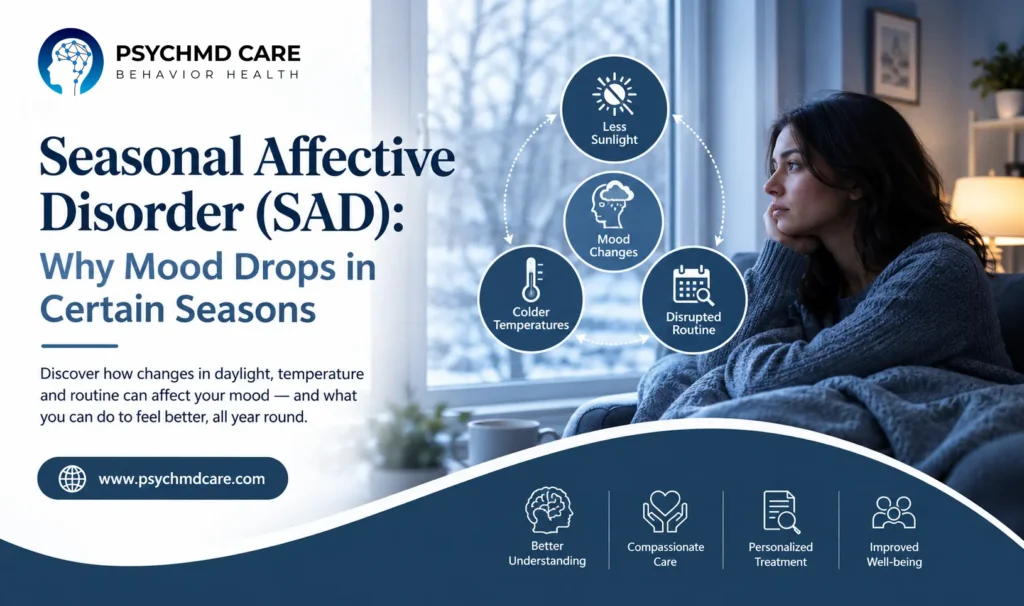
Seasonal Affective Disorder (SAD) is a form of depression tied directly to seasonal changes, especially in regions with stark contrasts in daylight. Individuals with SAD often experience recurring patterns of major depressive symptoms, primarily during autumn and winter, when daylight is scarce, although some may also experience these symptoms in the summer.
At PsychMD Care, we help patients recognize and manage SAD through light therapy, medication, lifestyle changes, and counseling.
Understanding Seasonal Affective Disorder
Just as the leaves turn or the days grow shorter, for some, mood seems to follow the sun’s timetable as faithfully as a morning commute. Seasonal Affective Disorder, commonly known by its downbeat acronym “SAD,” is not just the “winter blues.”
It’s a recognized mood disorder that tracks with the seasons and most often, appearing in late fall or early winter and easing as spring returns. Officially, SAD is labeled as “major depressive disorder with seasonal pattern” in the DSM-5, which puts it squarely in the landscape of serious, recurring mental health issues. SAD is particularly prevalent in higher latitudes, such as Canada and the northern United States, where the arrival of winter can make people feel as if sunlight is slipping away.
While “everyone feels a little sluggish when it’s 5 p.m. and pitch black,” as people often say, SAD is different and it’s the kind of low mood that disrupts everyday life: dragging out of bed, slogging through work, and wondering when the spark might return. Over the last decade, more awareness and public dialogue have helped people recognize seasonal depression symptoms early, changing “just power through it” into “there could be real help for those affected.”
Common Symptoms of Seasonal Affective Disorder
Let’s be direct: SAD is depression during winter months, cued by the changing rhythm of daylight and seasons. While seasonal depression symptoms can look like classic clinical depression, certain features stand out in this winter depression disorder. People usually report:
- Persistent feelings of sadness, hopelessness, or a “gloomy” outlook
- Loss of interest in activities, social withdrawal, or even a strong urge to “hibernate”
- Low energy and noticeable fatigue, some call it “feeling weighed down”
- Sleep changes: especially oversleeping (hypersomnia) in winter SAD, or insomnia if it strikes in summer
- Appetite changes and cravings for carbohydrate-heavy comfort foods and weight gain in winter-pattern SAD.
- Difficulty concentrating or making decisions
- Irritability that lingers longer than a cold snap
- In severe cases, thoughts of self-harm or suicide
For those who suffer from these symptoms, they may persist for four to five months at a time.
Interestingly, summer-pattern SAD tends to lean into anxiety, insomnia, or restlessness instead of oversleeping and overeating, turning the stereotype of “winter blues vs SAD” sideways.
What Causes Seasonal Affective Disorder?
Science hasn’t handed down a single, neat explanation, but the leading theory centers on sunlight or more precisely, its absence. Here’s where things get intriguing. The body’s internal clock, or circadian rhythm, closely ties the causes of seasonal affective disorder to cues from daylight. Removing those cues disrupts the delicate balance among mood-related brain chemicals.
Three key biological factors deeply link mental health and seasonal changes:
Serotonin:
Lower sunlight may mean less serotonin, the neurotransmitter that keeps mood level. Low serotonin is linked to depression one way or another.
Melatonin:
The hormone melatonin, which helps regulate sleep, ramps up as darkness grows. Extra melatonin in winter can lead to oversleeping, drowsiness, and that persistent feeling of moving through fog.
Vitamin D:
Less sun means less natural vitamin D, which plays a supporting role in serotonin regulation. Vitamin D deficiency is widespread in winter and might worsen SAD symptoms.
Some risk factors compound the problem, including a family history of depression, living far from the equator, younger age, female biological sex, and a personal or family history of mood disorders. Notably, people with bipolar II disorder are more likely to experience seasonal patterns.
The Science Behind SAD: How Seasons Affect Mood
Imagine trying to run your body’s internal software with faulty inputs. That’s what happens when less sunlight reaches your brain. The suprachiasmatic nucleus, a tiny region in the hypothalamus, uses sunlight to calibrate the body’s clock. Shorter days can create a hormonal domino effect, shifting sleep, appetite, and even how energy is burned.
Over time, the misalignment between natural rhythms and the environment starts to build. It’s not just an “I feel tired” kind of day; it’s a persistent brain-body sluggishness, almost as if winter’s chill seeps into motivation itself. Some studies suggest that negative thinking around winter (“here we go again, another long stretch of gray days”) can add to the psychological burden, but the main disruptors are serotonin, melatonin, and vitamin D—which have the starring roles in driving mood changes during seasons.
Diagnosing Seasonal Affective Disorder: Tests and Criteria
Seasonal Affective Disorder in DSM-5 and ICD-10
SAD isn’t a standalone psychiatric disorder but rather a specifier in the DSM-5 for major depressive disorder or bipolar disorder meaning the depression must repeat seasonally for at least two years and be more frequent than non-seasonal bouts. The ICD-10 categorizes it under recurrent depressive disorder with a seasonal pattern.
Seasonal Affective Disorder Test Options
Diagnosis often involves a clinical interview and sometimes self-assessment questionnaires, such as the Seasonal Pattern Assessment Questionnaire (SPAQ). There aren’t lab tests for SAD; instead, the process rules out other causes and looks for the distinctive, repetitive seasonal pattern. If you’re familiar with questions like “How do you feel from October to March?” your doctor’s likely screening for SAD.
Treatment Options for Seasonal Affective Disorder
Light Therapy for Seasonal Affective Disorder
Here’s some welcome news: Light therapy for seasonal depression works for many people and not just those who thrive in sun-soaked climates. Using a specially designed light box (10,000 lux), people spend 20–45 minutes each morning soaking up bright, UV-filtered light. The timing is everything. Get the dose right after waking to help reset the internal clock.
Light box or lamp:
Essential for most light therapy, but not just any lamp, will look for those intended for SAD use (“SAD lamp” or “light box for seasonal affective disorder”).
Dawn simulators:
Gradually increasing light in your bedroom to mimic sunrise is another strategy.
Response is often quick and sometimes within a week or two but benefits build over time. Notably, light therapy may not be safe for people with certain eye conditions or those taking medications that increase sunlight sensitivity, so professional guidance matters.
Medications and Supplements
Sometimes, light simply isn’t enough. As part of a broader SAD mental health treatment plan, selective serotonin reuptake inhibitors (SSRIs) such as fluoxetine or sertraline are commonly prescribed and help correct brain chemistry disruptions. Bupropion, another antidepressant, is FDA-approved for prevention of SAD when started in the fall. Effects from medication take weeks, not days, to show and so patience is part of the prescription.
Supplemental vitamin D is often recommended, particularly for those deficient in the winter months. Results are mixed regarding vitamin D’s independent impact on SAD, but supplementation is generally safe when monitored by a healthcare provider.
Lifestyle Strategies to Combat Seasonal Affective Disorder
Vitamin D and Nutrition
It’s tempting to think a bottle of vitamin D gummies might fix winter blues overnight, but the real power comes from consistent daily habits. Prioritize foods rich in vitamin D, like fatty fish or fortified products and discuss supplementation with a healthcare professional. For those living in northern regions, vitamin D levels tend to drop by late winter, with or without SAD.
Daily Habits and Self-Care Tips
Seasonal affective disorder treatment doesn’t end with a prescription and daily habits play a critical role:
- Keep a consistent sleep schedule: Set bedtime and wake times, even on weekends. Your body craves rhythm.
- Exercise regularly: Even a brisk outdoor walk helps, adding both daylight and movement.
- Stay socially engaged: Push against the urge to withdraw; connection counteracts loneliness.
- Choose balanced nutrition: While cravings spike for carbs, stable blood sugar helps keep mood more level.
- Get outdoors (even when it’s cold): Natural daylight, even on overcast days, helps regulate circadian rhythm.
The little routines are a morning coffee by the window, calling a friend, even rearranging lamps to brighten your space add up when managing seasonal mental health issues over months at a time.
Seasonal Affective Disorder Around the World
Prevalence in Canada and the United States
Here’s a remarkable nugget: In the United States, SAD affects roughly 1.4% of people in sun-rich Florida, but nearly 10% in light-starved Alaska. In Canada, the numbers are similar higher up north, where winter can mean weeks of short, dim days. Women and young adults are diagnosed far more often, and those with prior depression or family history are at increased risk. Interestingly, Iceland and Japan, despite their latitude, show lower rates—some researchers credit diet, especially regular fish consumption high in vitamin D.
Reverse Seasonal Affective Disorder
While most people consider SAD to be a winter phenomenon, the so-called “reverse SAD” appears in a small fraction of sufferers. These cases bring insomnia, restlessness, anxiety, and even weight loss during the longest, brightest days of summer. It’s less common, but for those affected, the intense sunlight and heat seem to throw the biological rhythms off-kilter in directions opposite to the winter depression disorder pattern.
Frequently Asked Questions About Seasonal Affective Disorder
The five most common seasonal depression symptoms are persistent sadness or low mood, loss of interest in activities, low energy and fatigue, oversleeping or disrupted sleep, and carbohydrate cravings with weight gain (winter-pattern).
Seasonal Affective Disorder can be a specifier applied to bipolar disorder, especially bipolar II, but most diagnosed cases involve major depressive disorder with a seasonal pattern. Understanding the difference between winter blues vs SAD and SAD vs bipolar requires a professional evaluation.
The leading cause of seasonal affective disorder is reduced daylight during certain seasons, disrupting circadian rhythms and altering levels of brain chemicals like serotonin and melatonin. Vitamin D deficiency may play a supporting role. Mental health and seasonal changes are closely interconnected through these biological pathways.
Most people respond well to a combination of light therapy for seasonal depression, antidepressants, vitamin D supplementation, and lifestyle changes like regular exercise, healthy eating, and structured daily routines. SAD mental health treatment is most effective when personalized connecting with mental health professionals is key if symptoms are persistent or severe.
Conclusion: Taking Steps Toward Better Seasonal Mental Health
For many, the dark months bring not just gray skies but heavy moods—yet Seasonal Affective Disorder is now recognized, treatable, and, increasingly, part of everyday health conversations. If seasonal patterns consistently drag your mood down, managing seasonal mental health issues is not something you have to do alone.
At PsychMD Care, we specialize in personalized seasonal affective disorder treatment—from light therapy and medication to counseling and lifestyle planning. No one needs to “just live with it.” Recognizing the signs, staying connected, and seeking appropriate treatment are the first, most powerful steps anyone can take toward brighter days ahead.
Ready to take the next step? Connect with the team at PsychMD Care today and get the support you deserve this season.